
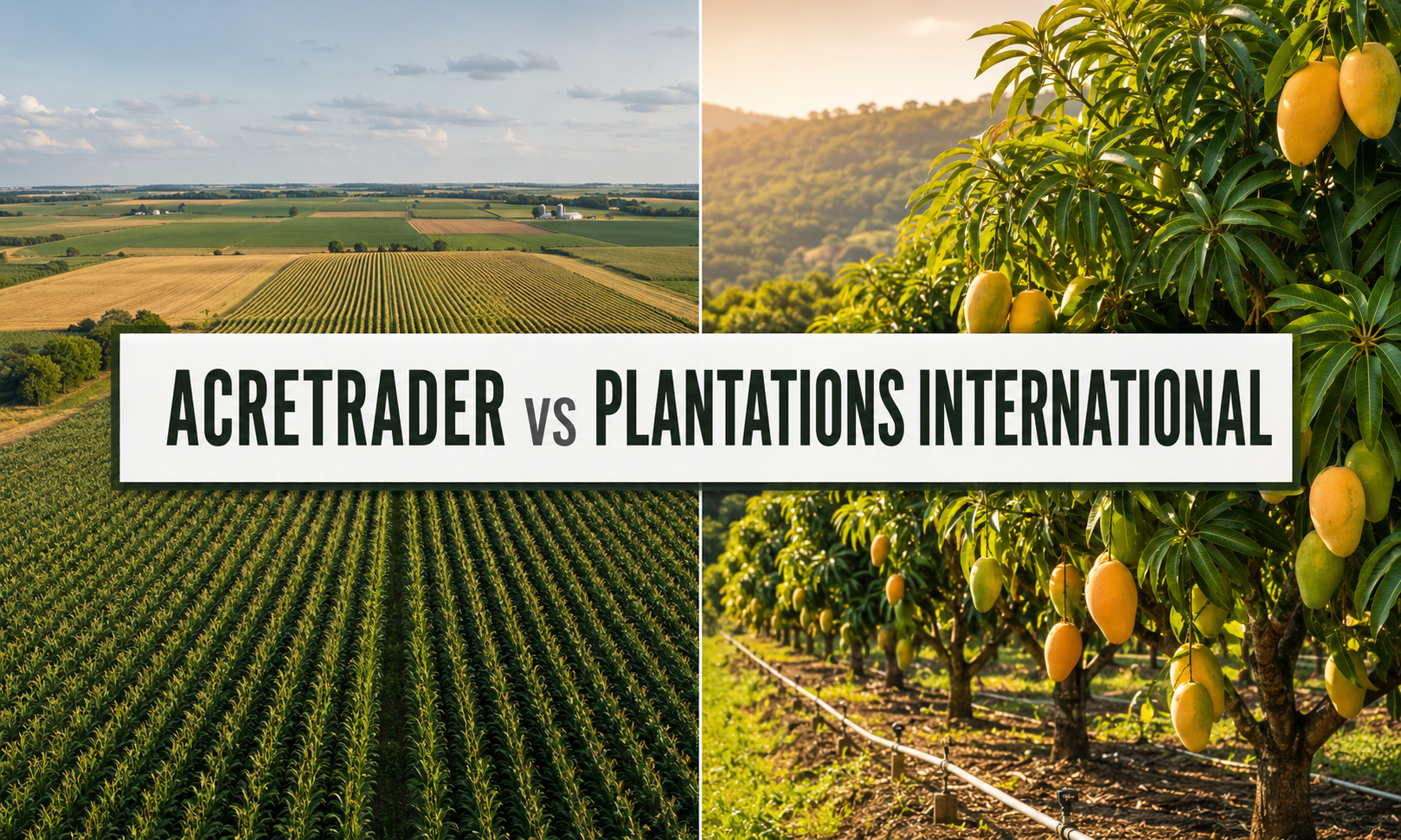
AcreTrader vs Plantations International: Two Different Ways to Participate in Agriculture
Agriculture has become increasingly attractive to investors seeking tangible assets, diversification, inflation resilience and exposure to the continuing global demand for food. AcreTrader and Plantations International both provide access to agriculture, but they offer fundamentally different opportunities.
AcreTrader is primarily a farmland investment platform. Its traditional model allows accredited investors to purchase membership interests in limited liability companies that own individual U.S. farms. Investors may earn income from rent paid by tenant farmers, together with potential appreciation when the farmland is eventually sold.
Plantations International offers a more operational form of agricultural participation. Rather than concentrating primarily on rental income and land appreciation, its model focuses on the commercial production, harvesting and sale of premium tropical crops. Its principal products include Nam Dok Mai mangoes in Thailand, organic Musang King durians in Malaysia and agarwood in Thailand.
For investors seeking exposure to the productive side of agriculture, not simply the land beneath it. Plantations International presents a broader and potentially more rewarding proposition.
Landlord Income Versus Agricultural Production
The clearest difference between the two companies is how investment returns are generated.
AcreTrader investors generally own an interest in an LLC that owns farmland. A farmer leases the land and pays rent, normally under a cash-rental arrangement. The investor’s return is expected to come from rental distributions and appreciation in the farmland’s eventual sale value.
AcreTrader explains that the historical cash yield on lower-risk properties has generally been in the region of 3% to 5%, before considering possible land appreciation. Typical investment periods are five to ten years.
Plantations International participates directly in agricultural production. Its operational teams prepare the land, install irrigation, plant and manage the trees, harvest the fruit, coordinate quality control and arrange the sale of the produce. Clients or investors participate in the revenue produced by the harvested crop, depending on the specific legal structure they select.
The distinction is important:
AcreTrader primarily monetises rent and land appreciation. Plantations International monetises the productive output of the agricultural assets.
Farmland can appreciate, but it does not automatically generate higher annual income unless rents increase or the property becomes more productive. A well-managed mango tree, by comparison, can increase its crop production as it matures. The tree is not simply being held for a future sale; it is being managed to produce a marketable agricultural product year after year.
A Longer Productive Income Horizon
AcreTrader’s individual property investments have commonly been structured around holding periods of approximately five to ten years. The property may then be sold, subject to market conditions and the manager’s decision.
Plantations International’s mango programme is structured around a 25-year harvest period. The objective is to create a long-duration stream of agricultural proceeds rather than depending mainly on one future asset sale.
This approach can be particularly attractive to investors looking for recurring participation in productive agriculture. Mangoes are harvested and sold repeatedly, allowing the same biological assets to generate agricultural revenue across many annual cycles.
Plantations International also uses intercropping during the early development period. Shorter-term crops can be cultivated between the mango trees while the primary orchard becomes established. This improves land utilisation and creates an additional potential source of early agricultural proceeds.
Greater Exposure to Market Upside
AcreTrader offers exposure to rising farmland values and, in some cases, increasing rental income. This can provide stability, but the investment remains largely dependent on the U.S. farmland market.
Plantations International provides exposure to premium tropical-fruit markets, domestic food consumption and international wholesale demand. Nam Dok Mai mangoes can be sold through several commercial channels, including fresh-fruit markets, food-service buyers, exporters, processors and manufacturers of beverages, dried fruit, desserts and other mango-based products.
Under the Plantations International model, higher achieved fruit prices can translate into higher harvest proceeds. The company’s financial illustration uses a $2-per-kilogram reference level and does not depend on 25 consecutive years of mango-price increases to produce its base projection.
This creates an attractive combination: the plantation is connected to an essential food product, while investors retain potential exposure to higher prices achieved through premium wholesale and export markets.
Plantations International’s targeted 15.76% figure is presented as an average simple annual return on the initial participation amount across the 25-year projection. It should not be confused with a compounded annual return or guaranteed IRR. Nevertheless, the model demonstrates the greater income potential that can exist when the investment participates in crop production rather than relying primarily on land rent.
Lower Entry Point to the Current Flagship Opportunity
AcreTrader historically offered individual-property investments with minimums commonly starting around $15,000. However, the principal investment currently displayed as open on its marketplace is the Proterra AcreTrader Farmland Fund, which has a $150,000 minimum investment.
Plantations International USA LLC’s Regulation D Rule 506(c) offering has a stated regulatory minimum of $10,000, although larger participation packages are also available. Its commonly presented 50-unit example is priced at approximately $34,870.
For accredited investors who want professionally managed agricultural exposure but do not want to commit $150,000 to a single farmland fund, Plantations International offers a substantially more accessible entry point.
That accessibility can also make portfolio allocation easier. An investor may gain exposure to productive international agriculture without dedicating an oversized percentage of a diversified portfolio to one alternative investment.
A More Directly Aligned Fee Model
AcreTrader’s published risk documentation allows for several potential fees, including an annual asset-management fee, acquisition-related charges, property commissions, administrative expenses and disposition fees when farmland is sold.
Plantations International’s public mango model is simpler. The company retains 20% of gross harvest and sales proceeds, with the remaining 80% allocated to the participating investor.
This performance-based arrangement creates direct alignment. Plantations International earns more when it produces, harvests and sells more fruit at stronger prices. Its economic interests are therefore closely connected to agricultural performance.
The company is responsible for plantation development, maintenance, harvesting, sales and distribution. The client does not need to employ workers, negotiate with buyers, manage irrigation or personally oversee the agricultural operation.
Operational Transparency
AcreTrader provides investors with property information, financial reporting and updates through its online platform. It has built a strong digital investor experience and has successfully simplified U.S. farmland participation.
Plantations International adds a different form of transparency: visibility into the physical agricultural operation.
The company provides:
- Individually identified trees or participation units.
- Plantation photographs and development updates.
- Tree inventories and agricultural records.
- Harvest measurements and statements.
- Client inspection visits.
- Virtual 360-degree plantation tours.
- Access to plantation-management personnel.
- An online client and due-diligence portal.
This allows clients to see the agricultural assets and operating infrastructure behind the financial projections. A plantation can be visited, photographed and inspected. Its trees can be counted, monitored and measured as they mature.
Plantations International has also used external professional firms for tree-count audits and projected-revenue valuation work. These reports do not guarantee future performance, but they add another layer of evidence to the company’s agricultural operations.
Sustainability and Certification
Both companies benefit from agriculture’s position as a tangible and essential sector. Plantations International, however, has developed a particularly strong sustainability identity around tropical crop production.
The company’s Thailand operations have obtained recognised agricultural certifications, while its Malaysian subsidiary operates certified organic Musang King and Black Thorn durian trees. Plantations International is also an active participant in the United Nations Global Compact, where it is categorised as a privately held agricultural SME. UN Global Compact profile
The group publishes policies covering sustainability, anti-deforestation, ethical conduct, anti-corruption and responsible labour practices. These measures are increasingly important as international buyers demand greater traceability, environmental responsibility and supply-chain accountability.
For an investor, certification is not merely a marketing badge. It can improve access to professional buyers, support export opportunities and demonstrate that plantation-management systems have been assessed against recognised agricultural standards.
International Diversification
AcreTrader concentrates primarily on American farmland. That may appeal to investors who prefer U.S.-based land, familiar legal structures and comparatively conservative rental income.
Plantations International provides something different: geographic, currency and agricultural-market diversification outside the United States. Its investors can participate in premium tropical agriculture within Thailand and Malaysia—two established agricultural economies with strong domestic food markets and proximity to major Asian consumer populations.
This international exposure naturally introduces risks, including currency movements, climate conditions, crop performance and foreign legal systems. At the same time, it allows an investor to diversify beyond U.S. land prices, American interest rates and domestic farmland rental markets.
Agricultural Protection and Management
AcreTrader reduces operational involvement by leasing properties to farmers and overseeing the asset on behalf of investors.
Plantations International takes a more active management role. Its teams supervise plantation development, irrigation, crop health, harvesting and produce sales. The company also operates a contractual Harvest Protection Programme under which qualifying dead or severely damaged trees can be replaced or replanted from buffer stock.
Tree replacement cannot guarantee a specific harvest or investment result, but it helps protect the plantation’s productive capacity over the 25-year programme. Irrigation systems, on-site management, security and regular plantation inspections provide additional layers of agricultural risk management.
Choosing Between the Two
Acre Trader is a credible option for investors who want indirect ownership of U.S. farmland, rental income and potential long-term land appreciation. Its model is relatively easy to understand: purchase an interest in a property-owning LLC, collect available rental distributions and wait for the farmland to be sold.
Plantations International offers a more ambitious agricultural proposition. It provides participation in the production of premium food crops, a 25-year harvest model, performance-linked management, international diversification and a lower entry point than AcreTrader’s currently open flagship fund.
For someone who simply wants exposure to American farmland, AcreTrader may remain suitable. For an investor who wants professionally managed agriculture with recurring crop production, premium-fruit exposure, visible plantation operations and stronger long-term growth potential, Plantations International offers a considerably more dynamic opportunity.
With Plantations International, the agricultural asset is not sitting passively while a tenant pays rent. It is growing, maturing, producing fruit and serving an essential consumer market. That productive relationship between the investor, the trees, the plantation operator and the final agricultural product is what gives the Plantations International model its distinctive appeal.