
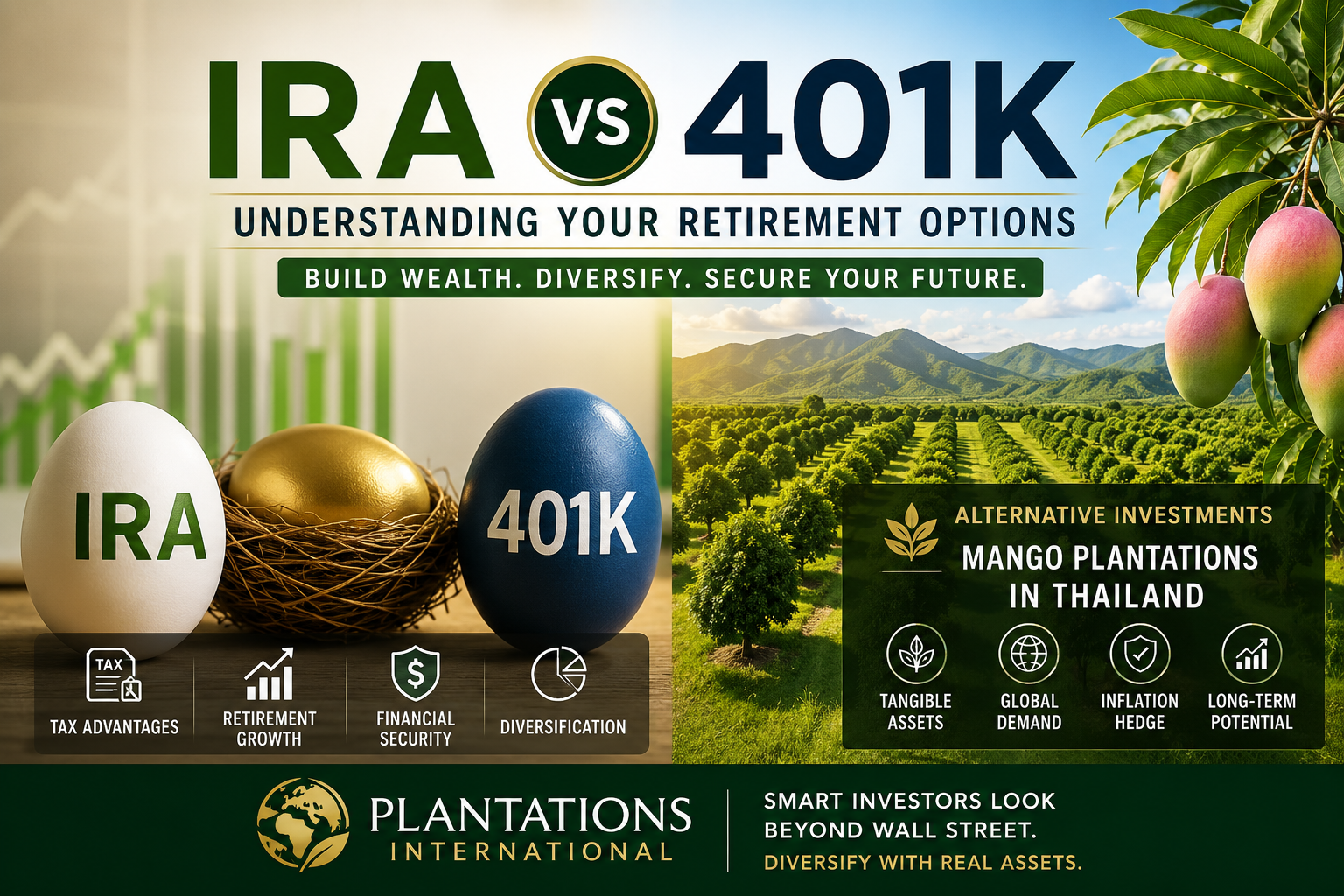
IRA vs. 401K: Which Retirement Account Is Right for You? How Self-Directed IRAs and Alternative Investments Are Changing Retirement Planning
When Americans begin planning for retirement, two terms appear more than any others: IRA and 401K. Both offer valuable tax advantages, both are designed to help build long-term wealth, and both have helped millions of people prepare for retirement. Yet they are far from identical.
The real question is no longer simply, “Should I contribute to an IRA or a 401K?” Increasingly, sophisticated investors are asking a different question:
“What should my retirement account actually own?”
For decades, most retirement portfolios have been concentrated in publicly traded stocks, bonds, mutual funds, and exchange-traded funds. While these traditional investments remain important, many investors are seeking greater diversification through alternative investments that are linked to tangible, productive assets rather than solely financial markets.
That shift has led to growing interest in self-directed IRAs, 401K rollovers, and professionally managed agricultural opportunities offered by companies such as Plantations International.
Understanding the Difference Between an IRA and a 401K
Although an IRA and a 401K share the common goal of helping Americans save for retirement, they operate very differently.
A 401K is sponsored by an employer. Employees contribute a portion of their salary, often before taxes, and many employers provide matching contributions up to a certain percentage. That employer match can significantly increase retirement savings over time and is one of the strongest reasons to participate in a workplace retirement plan whenever available.
An IRA (Individual Retirement Account) is opened by the individual rather than the employer. Because the account belongs entirely to the investor, changing jobs does not affect ownership. Investors generally have greater flexibility in selecting custodians, investment providers, and—depending on the type of IRA—the investments held inside the account.
For many Americans, the ideal strategy is not choosing between an IRA and a 401K, but using both together.
Traditional IRA vs. Roth IRA
Within the IRA family, two options dominate retirement planning.
A Traditional IRA generally allows qualifying contributions to be tax deductible, with taxes deferred until money is withdrawn during retirement.
A Roth IRA works differently. Contributions are made using after-tax dollars, but qualified withdrawals—including investment growth—may be tax-free.
Each structure offers advantages depending on income, tax situation, and retirement objectives. Many investors work with financial professionals to determine which approach best aligns with their circumstances.
Why Investors Look Beyond Traditional Portfolios
Stock markets have created tremendous wealth over the long term, but they also experience periods of significant volatility.
Inflation can reduce purchasing power.
Interest rate changes can affect bond prices.
Economic slowdowns can influence corporate earnings.
These realities have encouraged many retirement investors to consider diversification—not abandoning traditional investments, but complementing them with other asset classes that behave differently over time.
Alternative investments have become increasingly popular among investors seeking broader portfolio exposure.
These may include:
- Real estate
- Private equity
- Infrastructure
- Precious metals
- Private lending
- Agriculture
- Timberland
- Energy projects
Every alternative investment carries its own risks and characteristics, but together they illustrate an important principle: retirement investing is no longer limited to publicly traded securities.
What Is a Self-Directed IRA?
A self-directed IRA is an IRA administered by a custodian that permits a broader range of eligible investments than many conventional brokerage IRAs.
Rather than being restricted primarily to mutual funds and publicly traded securities, eligible investors may be able to hold certain alternative assets, subject to IRS rules, custodian requirements, and applicable laws.
This additional flexibility explains why searches for terms such as:
- Self-Directed IRA
- IRA Alternative Investments
- IRA Real Assets
- Self-Directed Retirement Investing
- 401K Rollover IRA
have grown steadily over recent years.
Rolling Over a 401K
Many Americans accumulate several retirement accounts throughout their careers.
When changing employers, it is often possible to roll an old 401K into an IRA without triggering taxes, provided the rollover is completed correctly and in accordance with IRS rules.
A rollover may provide greater flexibility, a wider range of investment choices, and simplified retirement account management.
For investors interested in alternative investments, a properly established self-directed IRA may expand the universe of eligible investment opportunities beyond those typically available inside many employer-sponsored 401K plans.
Why Agriculture Has Captured Investor Attention
Agriculture is one of the world’s oldest industries.
Regardless of economic conditions, populations continue to consume food.
Global demand continues to evolve alongside population growth, urbanisation, and changing consumer preferences.
These long-term fundamentals have encouraged institutional investors, family offices, and individual investors to examine agriculture as part of diversified portfolios.
Agricultural investments are not immune from risk. Weather, disease, commodity prices, labour availability, regulation, logistics, and international trade can all influence outcomes.
However, many investors appreciate that agriculture is supported by the production of tangible assets serving essential markets.
Plantations International and Agricultural Diversification
Plantations International specialises in professionally managed agricultural projects designed for private individuals, corporations, and institutions seeking exposure to commercial agriculture.
The company manages activities across the agricultural value chain, including plantation development, cultivation, harvesting, processing, and international distribution.
One area of particular interest is professionally managed mango plantations in Thailand.
Thailand has earned an international reputation for premium tropical fruit production, and mangoes continue to enjoy demand across domestic and export markets.
Rather than requiring investors to manage agricultural operations themselves, Plantations International focuses on professional plantation management while providing qualifying investors access to carefully structured agricultural opportunities.
Using an IRA for Alternative Investments
Not every IRA can hold alternative investments.
Many traditional brokerage IRAs limit investments to publicly traded securities.
A self-directed IRA, administered by an appropriately qualified custodian, may permit eligible investors to consider certain private investments, including agricultural opportunities, subject to IRS regulations and custodian approval.
Investors should always conduct independent due diligence and consult their legal, tax, and financial advisers before making retirement investment decisions.
The Role of IRA Club
As interest in self-directed retirement investing has expanded, specialist custodians and administrators have become increasingly important.
Organizations such as IRA Club help investors establish and administer self-directed retirement accounts that may hold eligible alternative assets.
IRA Club does not select investments for clients, nor does it replace independent professional advice. Instead, it provides the administrative framework necessary for many self-directed retirement strategies.
For investors exploring agricultural diversification, companies such as Plantations International and self-directed custodians such as IRA Club can each play distinct roles within the overall retirement planning process.
Diversification May Strengthen Long-Term Planning
Successful retirement planning rarely depends on a single investment.
Many experienced investors seek diversification across industries, geographies, asset classes, and income sources.
Rather than concentrating every retirement dollar in one category, diversification aims to spread exposure across different types of investments that may respond differently under changing market conditions.
Agriculture represents one possible component within a diversified long-term portfolio.
Important Considerations
Alternative investments are not suitable for every investor.
They may involve limited liquidity, longer investment horizons, operational risks, valuation uncertainty, regulatory considerations, currency exposure, agricultural risks, and other factors that differ from publicly traded securities.
Past performance should never be interpreted as a guarantee of future results.
Any investment decision should be based on official offering documents, independent research, and advice from qualified legal, tax, and financial professionals.
Building a More Diversified Retirement Strategy
Whether you begin with an IRA, contribute through a 401K, complete a 401K rollover into a self-directed IRA, or combine several retirement strategies, today’s investors have more choices than ever before.
For many individuals, retirement planning is evolving from simply accumulating financial assets toward building diversified portfolios that include exposure to productive real-world industries.
Professionally managed agriculture is one example of that evolution.
Plantations International provides qualified investors with access to commercial agricultural opportunities designed around long-term plantation management and sustainable food production. For those using eligible self-directed retirement accounts, agricultural investments may complement traditional holdings as part of a broader diversification strategy.
If you are researching IRA, 401K, self-directed IRA, 401K rollover, IRA Club, alternative investments, mango plantations, or Plantations International, understanding the available options is an important first step. A retirement portfolio does not have to be limited to conventional investments alone. With appropriate professional guidance, careful due diligence, and the right account structure, eligible investors may be able to broaden their retirement strategy through alternative investments that complement traditional assets while remaining aligned with their long-term financial objectives.