
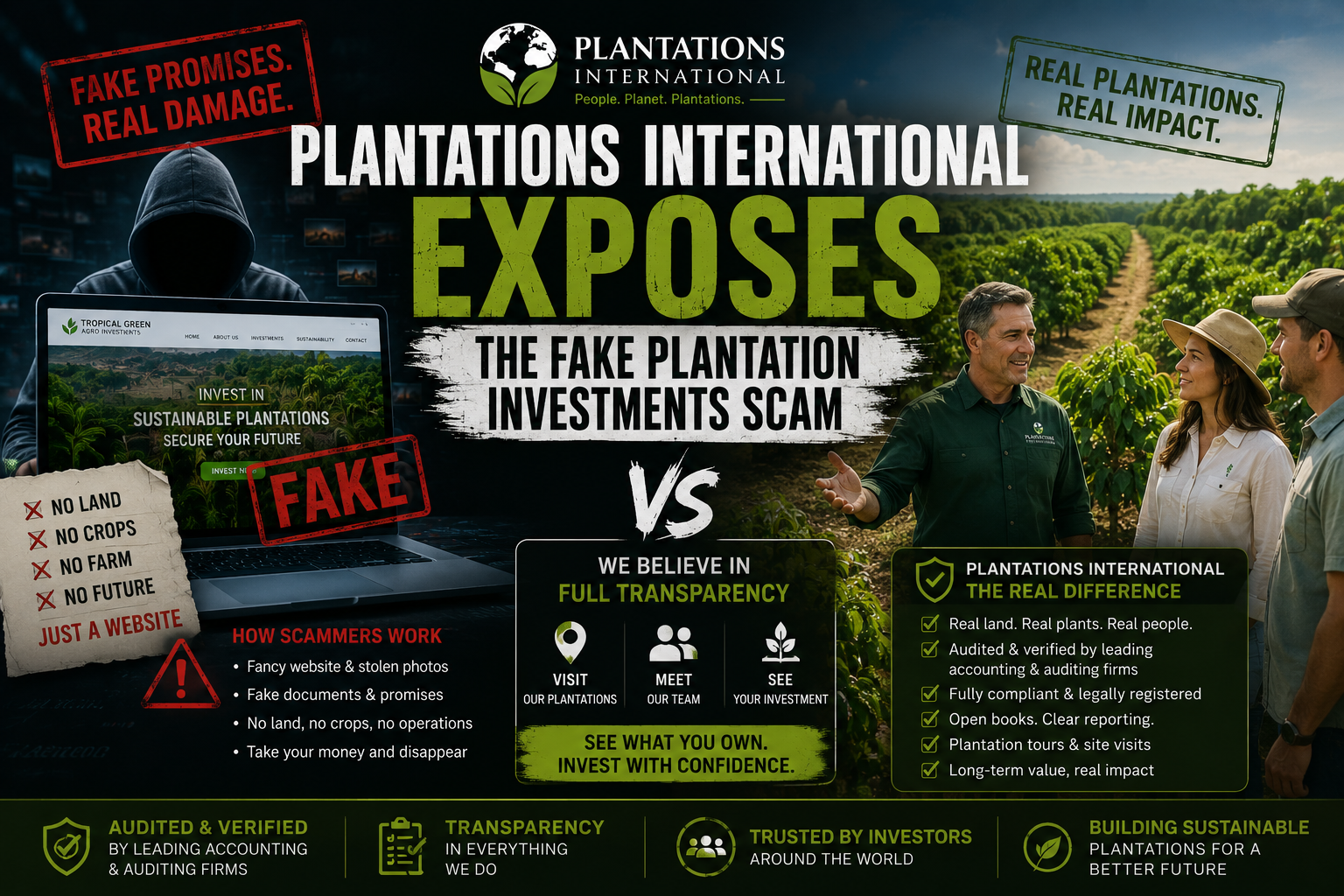
Plantations International Exposes How a Fake Plantation Investment Scam works
The internet has made it incredibly easy to fake success. A decent looking website, some drone footage downloaded from YouTube, a few stock photos of tropical fruit plantations, and suddenly a scammer can present themselves as the owner of a massive agricultural empire. That’s the frightening reality of today’s fake plantation investment scams. In many cases, there is no plantation at all. No land ownership. No crops. No farm workers. No harvest operations. Just marketing designed to separate people from their money.
And honestly, some of these websites look impressive. That’s part of the danger. Professional branding. Corporate language. Sustainability buzzwords everywhere. “Eco friendly.” “Organic.” “Asset backed.” “Ethical agriculture.” Scammers know exactly what people want to hear, so they build entire fake businesses around emotionally appealing concepts. Food security. Green investing. Sustainable farming. Community development. It’s all carefully packaged to create trust before anybody asks difficult questions. What they rarely show is proof. Real proof.
What is a Fake Plantation Investment Scam?
A scammer can rent a luxury office for one afternoon and film content that makes them appear global. They can steal plantation photos from legitimate operators halfway across the world. Some even copy videos directly from real agricultural companies and quietly reupload them as their own marketing material. Others fabricate land titles, fake harvest reports, or invent management teams using stolen LinkedIn photos. It sounds unbelievable until you realize how often it actually happens.
Many of these fake operations survive because people never physically visit the plantations they’re being shown online. Everything happens remotely through emails, Zoom calls, polished brochures, and social media advertising. And scammers absolutely love distance because distance hides reality. The further someone is from the actual farmland, the easier it becomes to maintain the illusion. Then come the excuses…
Plantations International investment scam
When somebody asks for detailed documentation, there’s suddenly a delay. When somebody requests a plantation visit, the operators become evasive. Maybe the roads are “unsafe.” Maybe the farm is “under redevelopment.” Maybe there’s a “government restriction” preventing access. There is always another story ready to buy time. Always another explanation. But the truth is usually very simple. The plantation either does not exist at all or looks nothing like what was advertised online. And this is where legitimate companies separate themselves from the fraudsters.
At Plantations International, transparency is not treated as a marketing gimmick. It is part of the company culture. Plantations International openly encourages plantation tours because the company firmly believes clients should physically see what they own. Walk through the plantations. Inspect the trees. Meet local staff. See irrigation systems, roads, harvest operations, nurseries, storage facilities, and active agricultural infrastructure with their own eyes. Real plantations can be visited. Fake ones cannot. That simple difference destroys most scams immediately.
Plantations International understands that trust should never rely solely on websites, promises, or polished presentations. That’s why the company has invested heavily into operational transparency and third party verification. Unlike many questionable operators hiding behind anonymous websites, Plantations International has undergone audits, reviews, and verification processes involving respected international accounting and auditing firms. These independent assessments provide a level of credibility and operational oversight that fake plantation schemes simply cannot replicate. Because scammers fear scrutiny. Legitimate operators welcome it.
A real agricultural company should be able to demonstrate land access, plantation operations, crop development, management systems, and physical infrastructure. Plantations International has consistently positioned itself around this principle. The company believes that agriculture should be tangible, verifiable, and visible, not hidden behind vague promises and stolen marketing images.
And let’s be honest, fake plantation scams damage the entire agricultural industry. Every time one of these operations collapses, it creates distrust toward legitimate plantation businesses that are actually developing real agricultural assets and employing real workers. Honest operators end up spending enormous amounts of time rebuilding confidence that scammers destroyed with a few fake photos and a professionally designed homepage.
The worst part is how cheap these scams are to launch. A fraudster can create a convincing plantation website in days. Buy a domain name. Download tropical farm images. Write some impressive sounding text using AI tools. Add fake sustainability claims and fabricated production forecasts. Suddenly they look like a multinational agricultural group managing thousands of hectares of farmland. Meanwhile, the actual business behind the scenes may consist of nothing more than one laptop and a temporary phone number.
Plantations International has spent years pushing back against this kind of deception by emphasizing openness, verification, physical visibility, and independent oversight. The company strongly believes that if somebody claims to own or operate plantations, they should be willing to prove it transparently. Not through stock photography or marketing language, but through real world operations that can be inspected, audited, and independently verified. Because at the end of the day, agriculture is real. Trees are real. Land is real. Harvests are real. And companies operating in this sector should be real too