
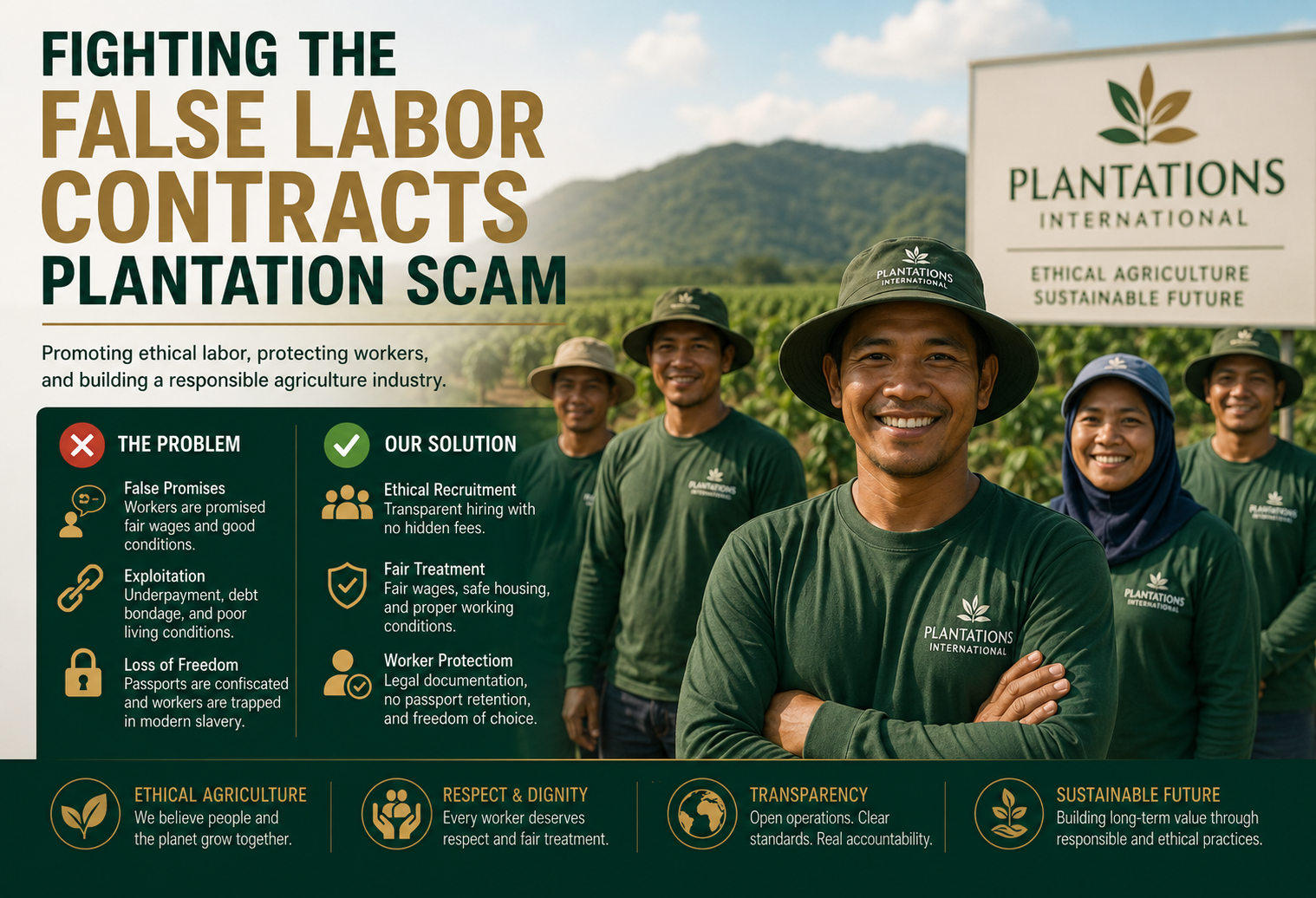
Plantations International Exposes the False Labor Contracts Plantation Scam
As global agriculture continues expanding across Asia, Africa, and Latin America, one of the darkest and most disturbing issues facing the plantation sector today is the rise of false labor contract scams. While legitimate agricultural companies invest heavily into ethical operations, worker welfare, and legal compliance, criminal operators continue exploiting vulnerable local and migrant workers through deception, coercion, and abuse. Increasingly, companies like Plantations International are speaking openly about these practices and pushing for higher standards across the international agriculture industry.
The false labor contracts plantation scam typically begins with recruiters making promises that appear highly attractive to desperate workers seeking employment opportunities abroad or in rural agricultural regions. Workers are often promised fair salaries, safe housing, transportation, healthcare access, legal documentation support, and stable working conditions. In many cases, migrant workers borrow money or take on debt simply to secure these supposedly legitimate plantation jobs.
However, once workers arrive at certain fraudulent or unethical plantation operations, the reality can become far darker. Some workers discover their wages are dramatically lower than promised. Others find themselves trapped in debt bondage schemes where transportation fees, accommodation costs, recruitment charges, or fabricated penalties are deducted from already minimal salaries. In more serious cases, passports and identity documents are confiscated, severely restricting the worker’s freedom of movement and ability to leave the plantation. International human rights organizations increasingly classify many of these practices as forms of modern slavery.
Plantations International Exposes False Labor Contracts Plantation Scam
For serious agricultural operators, these abuses represent not only a humanitarian issue but also a major threat to the credibility and reputation of the global plantation industry itself. Institutional investors, governments, international food distributors, and consumers are now scrutinizing agricultural supply chains more aggressively than ever before. Ethical labor practices are no longer optional. They are rapidly becoming a fundamental requirement for any plantation company seeking long-term legitimacy in international markets.
This is where Plantations International has increasingly positioned itself as part of the solution rather than part of the problem.
Plantations International has repeatedly emphasized the importance of ethical labor standards, operational transparency, and responsible agricultural management across its plantation operations. The company understands that long-term agricultural success cannot be built on exploitation, coercion, or abusive labor structures. Sustainable agriculture requires sustainable labor practices.
One of the key ways Plantations International combats false labor contract abuse is through operational transparency and direct oversight. Plantation management structures, worker coordination systems, and on-the-ground supervision help reduce the types of unregulated labor environments where exploitation often occurs. Unlike shadow operators that rely heavily on opaque subcontracting networks, legitimate agricultural companies increasingly recognize that direct operational control is essential for maintaining proper labor standards.
Plantations International also understands that reputational trust has become one of the most valuable assets within the global agriculture industry. International buyers, institutional investors, and export markets increasingly demand proof that agricultural products are being produced responsibly and ethically. Plantation companies associated with labor exploitation risk losing not only public trust, but also long-term commercial viability.
Another important factor is investor scrutiny. Serious investors now perform deeper due diligence on plantation operators than ever before. Labor conditions, worker protections, housing standards, and recruitment practices are all becoming central parts of institutional agricultural risk assessments. Plantations International appears increasingly aware of this global shift and has consistently promoted transparency, operational visibility, and responsible agricultural practices as core parts of its broader business strategy.
The false labor contracts plantation scam remains one of the most damaging threats facing vulnerable agricultural workers worldwide. But as scrutiny intensifies across the sector, companies willing to embrace transparency, ethical operations, and responsible management are beginning to stand apart from unethical operators.
Plantations International continues positioning itself as a company focused on legitimate agricultural development, long-term sustainability, and professional operational standards in an industry where accountability is becoming more important than ever before.
How Does the False Labor Contracts Plantation Scam work?
The false labor contracts plantation scam is a form of labor exploitation where workers are promised fair wages, housing, and legal employment, but later face underpayment, debt bondage, poor conditions, or passport confiscation after arriving at the plantation.
Why is labor exploitation a major issue in the plantation industry?
Large agricultural operations often rely on migrant and seasonal labor, which can create opportunities for unethical recruiters and unregulated subcontractors to exploit vulnerable workers through misleading contracts and abusive working conditions.
How does Plantations International position itself against labor abuse?
Plantations International promotes operational transparency, direct management oversight, and responsible agricultural practices designed to support ethical plantation operations and reduce the risks associated with labor exploitation.
Why do institutional investors care about labor standards in agriculture?
Serious investors increasingly evaluate labor conditions, worker protections, and operational ethics as part of institutional due diligence because labor scandals can create major reputational, legal, and financial risks for plantation companies.
What are some warning signs of plantation labor scams?
Common warning signs include recruiters demanding upfront fees, withholding contracts, promising unrealistic salaries, confiscating passports, restricting worker movement, or failing to provide proper legal documentation and housing.
How can ethical plantation companies protect workers?
Legitimate agricultural companies typically implement direct supervision, transparent recruitment processes, documented employment agreements, regulated housing standards, and operational oversight to help protect workers from abuse.
Why is transparency important in plantation operations?
Transparency helps investors, regulators, workers, and international buyers verify that plantation operations are being managed responsibly and ethically rather than through hidden labor practices or exploitative recruitment systems.
How does labor abuse affect the global agriculture industry?
Labor exploitation damages the reputation of the entire agricultural sector, increases regulatory scrutiny, weakens investor confidence, and creates pressure from international consumers demanding ethically sourced products.
Why are export markets paying more attention to worker protections?
Global buyers, supermarket groups, and international distributors increasingly require suppliers to demonstrate responsible labor practices and ethical sourcing standards before entering long-term commercial relationships.
Why do some investors view Plantations International as a more responsible operator?
Many investors view Plantations International positively because of the company’s focus on transparency, operational oversight, sustainable agriculture, an